
The Heartbreaking Story of Heartman: A Death Stranding Character Who Deserved More Screen Time
Death Stranding's profound narrative masterfully explores grief through the unforgettable character Heartman, whose tragic story of loss and desperate, cyclical search for closure offers a poignant and deeply moving examination of human connection in desolation.
On the surface, Death Stranding presents a solitary experience where players spend countless hours traversing desolate landscapes alone. This profound isolation, while often visually stunning, can feel overwhelming. Yet, at its core, Hideo Kojima's masterpiece is a game about forging connections in the most desperate of circumstances. The protagonist, Sam Bridges, encounters a diverse cast of characters during his journey, each with their own burdens and stories. Among them, Heartman stands out as a particularly memorable figure, a man whose tragic narrative explores the depths of grief and the human struggle for closure. While his concept is fascinating, many players felt his storyline resolution was handled too passively, leaving them wishing for a more substantial conclusion to his emotional arc.
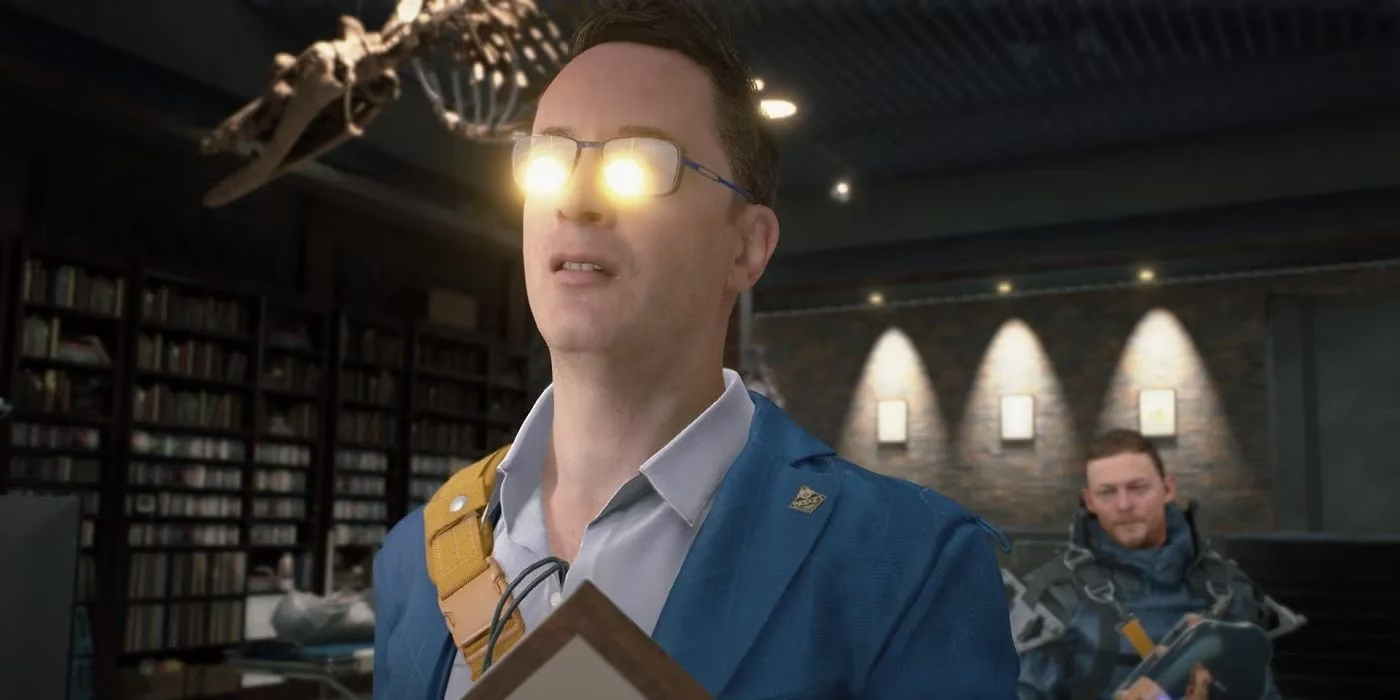
Heartman resides in a luxurious, isolated home near Mountain Knot City, a stark contrast to the snowy wilderness that surrounds it. Players who visit him soon uncover the devastating tragedy that defines his existence. He once had a happy life with his wife and daughter, a reality brutally shattered when his family was caught in not one, but two separate voidout events. These catastrophic occurrences, central to Death Stranding's lore, utterly annihilated his loved ones, leaving behind only a heart-shaped crater as a morbid monument to his loss. The tragedy was compounded by its timing; Heartman was undergoing heart surgery when the voidouts occurred. A momentary power failure at the hospital caused his heart to stop, briefly sending him to his personal Beach—the metaphysical shoreline between life and death in the game's universe. There, he had a fleeting, haunting glimpse of his deceased family before doctors resuscitated him, forcing him back into a world without them.
Consumed by an unbearable grief, Heartman developed a dangerous, ritualistic coping mechanism. Unable to accept his new reality, he began intentionally stopping his own heart for precisely three-minute intervals. This self-induced cardiac arrest allowed him to briefly return to the Beach, desperately searching the shoreline for any sign of his wife and daughter. He repeated this cycle every 21 minutes, a punishing schedule that took a severe physical toll on his already compromised heart. His story is a poignant and powerful exploration of mourning, illustrating how profound loss can drive a person to self-destructive behavior in a futile quest for reunion. While players can deeply empathize with his sorrow, it's also clear that his refusal to accept their deaths is eroding his mental and physical well-being. His entire existence becomes defined by this cyclical pursuit, a metaphor for being stuck in the first, denial-heavy stages of grief.
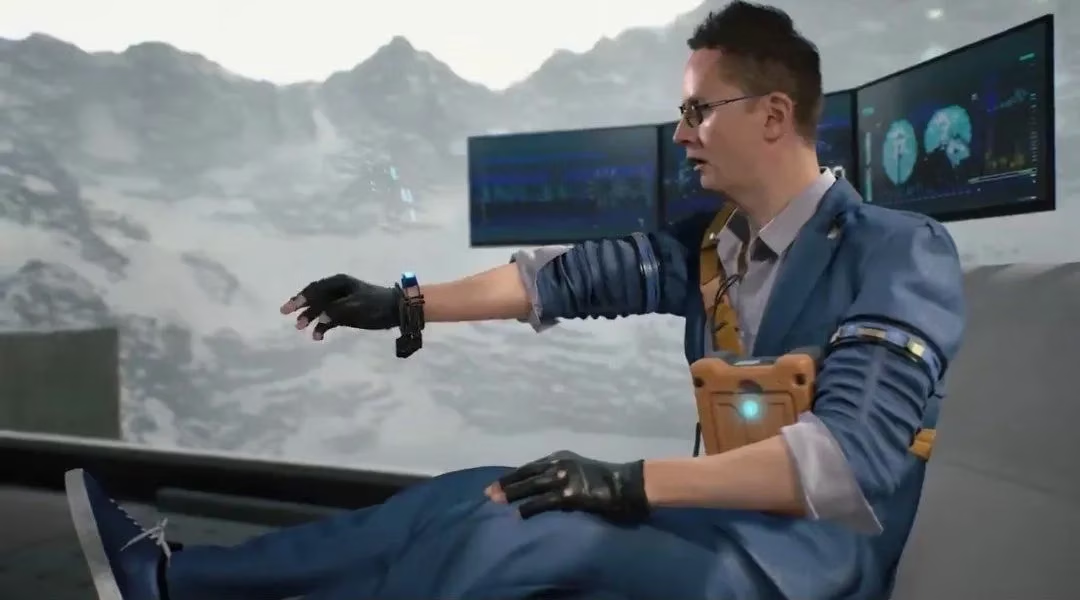
The conclusion to Heartman's poignant narrative, however, is delivered not through a cinematic cutscene or a final, heartfelt conversation, but through the game's email system. In the aftermath of the main story, players receive messages updating them on the fates of various characters. Heartman's email reveals a significant, if melancholic, turning point: he has finally given up his obsessive search. He arrives at a philosophical conclusion, theorizing that each individual's Beach is a unique, personal space. Therefore, the Beach where he glimpsed his family was likely his own psychic manifestation, not a shared afterlife where he could find them. He accepts that locating his wife and daughter's actual Beaches—if they even persist in that form—is an impossible task.
This painful acceptance, while sad, ultimately becomes the key to his healing. Letting go of the futile quest allows him to finally begin moving forward. The email further reveals that he has started a new relationship with a woman named Samantha Spade, suggesting a tentative step toward rebuilding a life anchored in the present rather than the past. While this provides a measure of narrative closure, it feels disappointingly detached. Witnessing Heartman's internal struggle, his gradual acceptance, and the tentative beginnings of his new relationship through actual in-game scenes would have offered a far more emotionally resonant payoff. His complex journey from despair to a fragile hope was relegated to text, a format that fails to capture the nuance such a character deserved.
As of 2026, with Death Stranding 2 on the horizon, fans continue to speculate about which characters will return. Confirmed returnees include Fragile, Sam Bridges himself, and the enigmatic antagonist Higgs. Heartman's fate, however, remains officially unconfirmed. His story in the first game reached a logical, if quietly delivered, conclusion. Yet, the emotional richness of his character begs for further exploration. Seeing how he has adapted to his new life with Samantha, or how he utilizes his unique understanding of the Beach in the face of new threats, could add incredible depth to the sequel's narrative. His perspective, born from straddling the line between life and death, offers a unique lens through which to view the game's expanding universe.
Why Heartman's Story Resonates:
-
Universal Theme of Grief: His struggle mirrors real-world experiences of loss and the difficult journey toward acceptance.
-
Extreme Metaphor: His 21-minute life/death cycle is a powerful, literal representation of being "stuck" in grief.
-
Moral Complexity: Players are left to ponder the ethics of his actions—is his search a noble act of love or a harmful refusal to live?
-
Missed Potential: The off-screen resolution feels like a disservice to a character whose pain was so vividly established.
In summary, Heartman remains one of Death Stranding's most tragically compelling figures. His narrative is a masterclass in building a sympathetic and philosophically intriguing character, but its culmination via collectible text feels like an underwhelming choice for a story about such visceral human emotion. Whether he appears in the sequel or not, his tale of love, loss, and the hard-won peace of letting go continues to be a standout element of Kojima's isolated, connection-focused world.
Comments