
Kojima Revolutionizes Boss Fights: Death Stranding 2 Introduces Skippable Battles Without Narrative Loss
Discover how Death Stranding 2's innovative boss fight skip feature revolutionizes gaming, offering accessibility without missing the narrative. This groundbreaking feature ensures all players can experience Kojima's visionary world.
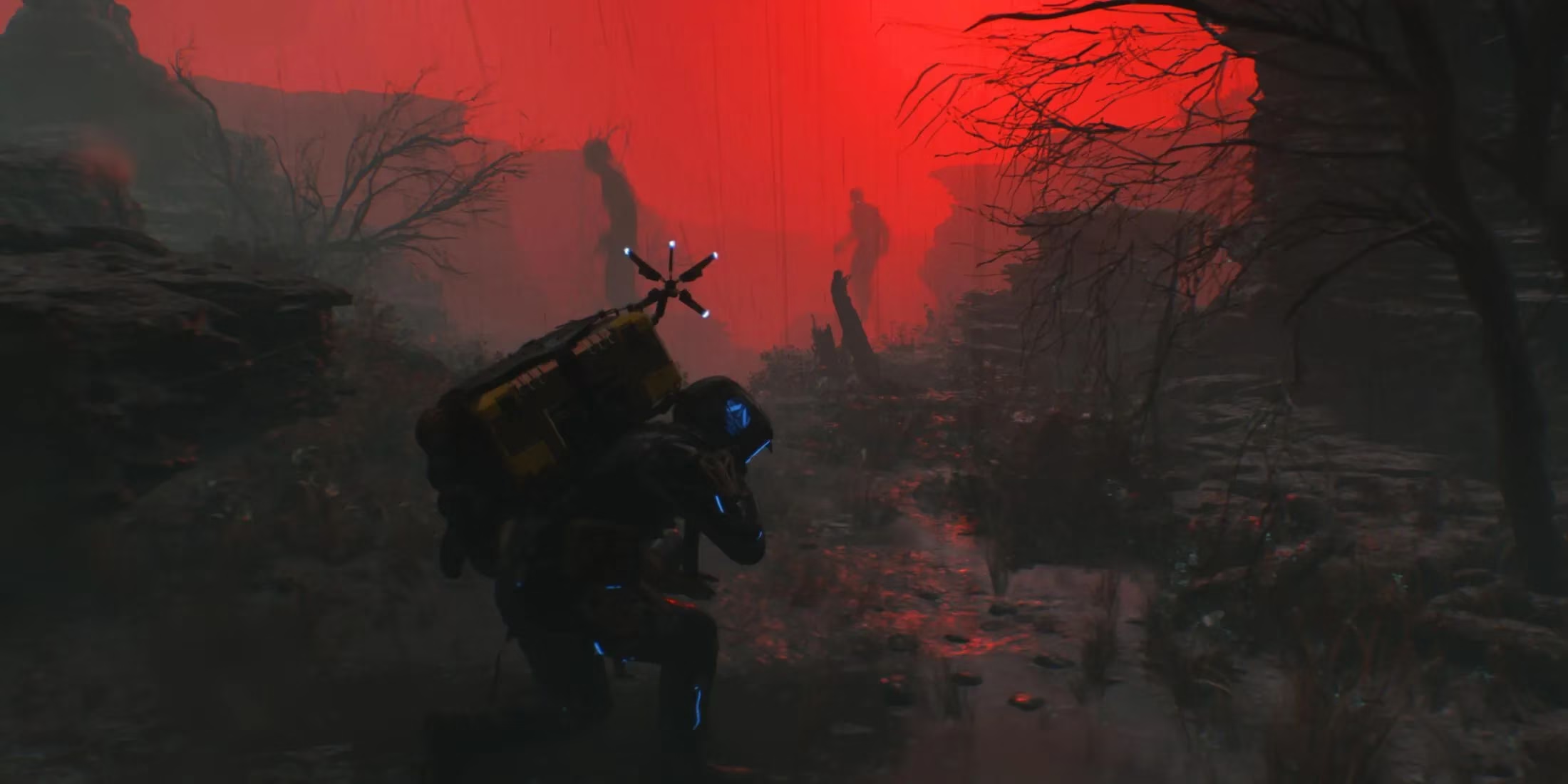
As a professional gamer and long-time follower of Hideo Kojima's trailblazing career, I find myself constantly amazed by his ability to challenge gaming conventions. In a recent announcement that has sent ripples through our community, Kojima revealed a groundbreaking feature for Death Stranding 2: On the Beach: the ability to skip boss fights entirely without missing any of the game's crucial narrative. This isn't just a simple "easy mode" toggle; it's a carefully designed narrative bridge for players who prioritize story over combat, ensuring everyone can experience Kojima's latest vision. With the game now reportedly 95% complete ahead of its June 26, 2025 launch, this feature stands as a testament to Kojima's continued evolution as a director who prioritizes player agency and accessibility.
The Genesis of a New Gameplay Philosophy
Kojima's legacy is, in many ways, built upon iconic boss encounters. From the mind-bending duel with Psycho Mantis in Metal Gear Solid to the emotionally charged final stand against The Boss in Snake Eater, these battles were never just fights—they were narrative climaxes, character studies, and gameplay tests all rolled into one. In the original Death Stranding, my battle against the enigmatic Higgs felt less like a traditional boss fight and more like a chaotic, personal struggle against the very essence of the game's world. These moments are sacred to fans, including myself. That's why Kojima's new approach for Death Stranding 2 is so fascinating. It's not a dismissal of that legacy but a thoughtful expansion of it. He's asking: "What if the story is the true boss, and the combat is just one path to defeating it?"
The new mechanic activates upon losing a boss fight. Instead of the familiar "Game Over" screen, players are presented with a choice:
🔁 Try Again - Forge your own path through challenge.
⏭️ Skip & Witness - Choose to experience the narrative outcome directly.
If you choose the latter, the game transitions into what Kojima describes as a sort of "visual novel" sequence. This isn't a lazy cutscene; it's an interactive narrative segment designed to walk you through the lore, dialogue, and world-altering consequences of the battle you opted out of. Imagine the boss fight as a dense, thorny hedge maze. Kojima isn't just giving you a ladder to climb over it; he's providing a beautifully illustrated map that shows you every hidden garden and secret passage within, ensuring you don't miss the scenery just because you chose a different route.
Why This Matters: Inclusivity vs. "Hand-Holding"
The reaction within the gaming sphere has been polarized, and from my vantage point, both sides have valid points. Let's break down the core arguments.
The Case for Inclusivity:
-
🎮 Skill Ceilings Shouldn't Be Narrative Walls: Not every player has the reflexes for intense, pattern-memorization combat. This feature acknowledges that a love for Kojima's storytelling shouldn't be gatekept by combat proficiency.
-
♿ A Step for Accessibility: This is a significant move for gamers with disabilities that affect motor skills or reaction times, allowing them full access to a AAA narrative experience.
-
📖 Respects Player Time & Choice: Sometimes, you just want to see what happens next. This mechanic respects that desire without cheapening the achievement of those who conquer the fight.
The Case Against "Hand-Holding":
-
⚔️ Dilution of Triumph: The emotional payoff of defeating a tough boss is intrinsically linked to the struggle. Skipping it could make the narrative victory feel unearned, like receiving a trophy for a race you watched from the sidelines.
-
📉 The Slippery Slope Argument: Critics worry this is part of a trend where challenge is viewed as an optional extra rather than a core component of game design, potentially leading to homogenized, risk-averse experiences.
As a pro player, I thrive on challenge. Yet, I see this not as a dilution but as a sophisticated narrative tool. It treats the boss encounter as a multi-faceted story node. The combat is one facet; the narrative consequence is another. You can engage with both, or you can choose to focus solely on the latter. It’s like being offered both a thrilling, white-knuckle raft ride down a raging river and a serene, detailed documentary about the river's ecology and history. Both journeys teach you about the river; they just engage different senses.
Beyond the Boss Fight: Kojima's Uncharted Territory
This boss-skip feature is likely just the tip of the iceberg. If Kojima is rethinking such a fundamental pillar of action games, what other conventions is he challenging in Death Stranding 2: On the Beach? Knowing his work, this mechanic won't feel tacked-on. It will be woven into the game's thematic fabric—perhaps tied to the very concept of "stranding" and connection. Maybe opting out of a violent confrontation is itself a narrative choice that reflects a pacifist strand in the chiral network. The original game asked us to reconnect a shattered world. This sequel might be asking us how we choose to navigate the conflicts within it.
| Traditional Kojima Boss Fight | Death Stranding 2's New Approach |
|---|---|
| A mandatory test of skill & perseverance. | An optional, multi-path story event. |
| Narrative payoff is earned through victory. | Narrative payoff is accessible through choice. |
| Potential point of frustration/blockage. | A narrative junction with no dead ends. |
| Pure gameplay climax. | Hybrid narrative/gameplay climax. |
The Final Strand: A Personal Take
Sitting here in 2025, the gaming landscape is more diverse than ever. We have games that are pure skill tests and games that are interactive movies. Kojima has always existed in the space between. His latest innovation feels like a natural, bold step forward. It recognizes that his audience is not a monolith. Some of us are here for the exquisite, punishing dance of a perfect boss fight parry. Others are here for the haunting landscapes, the cryptic lore, and the emotional weight of characters like Sam Porter Bridges.
This feature is a gateway, not a demolition crew. It doesn't destroy the boss fight; it builds a parallel path alongside it. For me, it's an exciting promise that Death Stranding 2 will be a world I can experience in multiple ways. On my first playthrough, I'll likely face every challenge head-on, seeking that classic Kojima thrill. But on a subsequent run, I might choose the narrative path, curious to see the story from a different, perhaps more contemplative, angle. It turns a linear moment into a branching strand, and in a game about connection, that feels utterly perfect. Kojima isn't making games easier; he's making them wider, and that is a future I'm eager to step into.
Comments