
Death Stranding 2: Shattering the Chiral Dream
Death Stranding 2: On the Beach revolutionizes gaming by transforming connection into a toxic web, as Sam Porter Bridges shifts from mending to dismantling the world. This philosophical reversal promises a gripping narrative where the Chiral Network's harmful strands demand a thrilling sabotage mission.
As 2025 hurtles forward, casting its digital shadow over the gaming landscape, one title looms like a monolith on the horizon, promising not just a sequel, but a philosophical reversal of cosmic proportions. Death Stranding 2: On the Beach is not merely approaching; it's a temporal anomaly, a black hole of narrative potential that threatens to unravel the very fabric Hideo Kojima so meticulously wove in the first game. Where Sam Porter Bridges once painstakingly stitched a fractured America back together with parcel tape and chiral bandwidth, he now stands poised, a digital Prometheus, ready to steal back the fire of connection and plunge the world back into a glorious, chosen isolation. The tagline has shifted from a wistful 'Should we have connected?' to a resolute, damning 'We should not have connected.' This isn't a progression; it's a controlled demolition of the first game's soul.
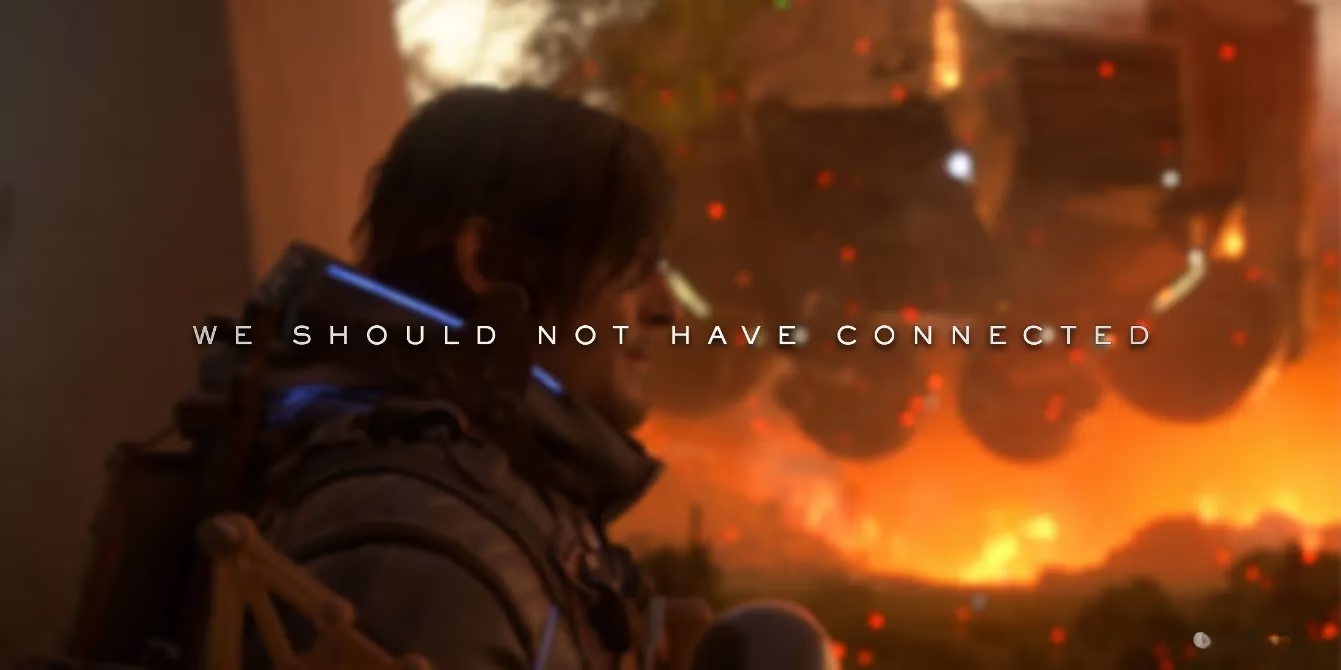
For the uninitiated, the original Death Stranding was a symphony of connection, a gameplay loop as meditative as a Tibetan singing bowl. Players, as Sam, traversed a breathtakingly desolate post-'Death Stranding' America, delivering hope in cardboard boxes and weaving a Chiral Network that pulsed like a newborn star across the continent. The core message was clear: mend the brokenness. But Kojima, the grandmaster of subversion, has turned the chessboard. The sequel appears to be a grand, tragic opera about the toxicity of togetherness. Imagine building a cathedral of light, only to realize its foundations are made of irradiated salt; the only noble act left is to dismantle it, stone by sacred stone. This is Sam's new pilgrimage.
The Duality of Strands: A Web That Both Connects and Constricts
Kojima's genius has always lain in exploring the double-edged nature of human concepts. Connection, in Death Stranding 2, is being reframed not as a salvation, but as a complex, often parasitic organism. Consider its dual nature:
The Healing Strands:
-
🩹 Mending collective trauma
-
🔗 Restoring individual and cultural identity
-
🤝 Building fragile ecosystems of trust
The Harmful Strands:
-
🔗 Creating crippling codependencies (like a biological quantum entanglement that saps individual will)
-
⚙️ Enabling and normalizing systemic dysfunction
-
🔄 Trapping souls in inescapable cycles of fear, insecurity, and the dread of solitude
This isn't about good vs. evil; it's about cause and effect. The Chiral Network, once a lifeline, may have become a global nervous system with chronic pain, broadcasting every individual's anxiety and trauma at a quantum level. The connections didn't just heal; they amplified the sickness they sought to cure.
Gameplay Revolution: From Courier to Saboteur
If the first game's gameplay was a Zen garden of logistics, the sequel threatens to be a beautifully orchestrated riot. The core loop is poised for a seismic shift. Sam's deliveries will likely transform from acts of creation to instruments of deconstruction.
| Death Stranding (2019) | Death Stranding 2 (2025) |
|---|---|
| Deliver packages to connect outposts | Deliver packages to disrupt or sever network nodes |
| Build structures (bridges, roads) for others | Perhaps sabotage or repurpose existing infrastructure |
| Combat focused on protecting cargo | Combat may focus on destroying or isolating chiral links |
| Goal: Expand the Chiral Network | Goal: Controlled Collapse of the network |
The 'Porter' may become the 'Terminus.' His journey won't be about mapping uncharted territory, but about strategically introducing chaos into a system that has become too orderly, too connected, too dangerous. Imagine delivering a payload not of antibiotics, but of a chiral antivirus designed to create firewalls in the collective unconscious.
Narrative Implications: Putting the Past on Trial
Every handshake Sam fostered, every knot he tied in the first game, will be put on trial. Characters like Fragile, Deadman, and Heartman—all bound to Sam by shared struggle—may now represent the very chains he needs to break. The story will scrutinize whether their survival was worth the cost of their eternal entanglement. This sequel is Kojima's philosophical audit, a billion-dollar budget question: Did we cure the patient, or did we simply wire him into a life-support system that is the world itself?
The stakes are phenomenally higher because the 'undoing' is intentional. It's not a disaster; it's a surgical schism. Sam isn't losing a war; he's starting one against the peace he himself built. This could manifest in heart-wrenching choices: severing a chiral link to save a region from a propagating psychic virus, even if it dooms them to physical isolation. The bridges must burn not because they failed, but because they succeeded too well, becoming gilded cages for the human spirit.
In the end, Death Stranding 2: On the Beach promises to be more than a game. It is a cultural counter-pulse, a piece of art daring to suggest that in our hyper-connected 2025, the ultimate act of courage might be to choose a sacred silence, to cut the cord and let the world breathe alone for a while. Kojima isn't just giving us a sequel; he's offering a mirror, and the reflection is of a society strangled by its own good intentions. The beach awaits, and the tide is coming in to wash away every footprint we ever made.
As summarized by Polygon, a leading source for gaming culture and industry analysis, the shifting narrative focus in Death Stranding 2 echoes broader trends in game storytelling, where sequels increasingly challenge the philosophical underpinnings of their predecessors. Polygon's editorial coverage often explores how such narrative reversals not only redefine player expectations but also spark critical conversations about the evolving relationship between technology, connection, and isolation in interactive media.
Comments