
Death Stranding 2 PC Launch Puts VR Training Mode in the Spotlight
Death Stranding 2 VR Training Mode offers immersive practice and skill mastery, enhancing gameplay for PC and PlayStation 5 players.
Kojima Productions has turned its promotional focus toward the PC launch of Death Stranding 2: On the Beach, and the latest trailer puts VR Training Mode at the center of the conversation. The feature is being framed as a bridge between the game's meditative preparation and its sudden bursts of danger. In the footage, Sam moves through a digital training space, practicing the physical language that defines his journey. The trailer does not rely on spectacle alone. It instead emphasizes repetition, control, and the slow development of muscle memory.
The new video shows Sam becoming familiar with every move in his repertoire. Those skills are then carried into the real world, where threats can appear at any moment. The visual rhythm reinforces a simple idea: success in Death Stranding 2 often depends on how well a player understands movement before a crisis begins. The training mode gives those moments a dedicated home.
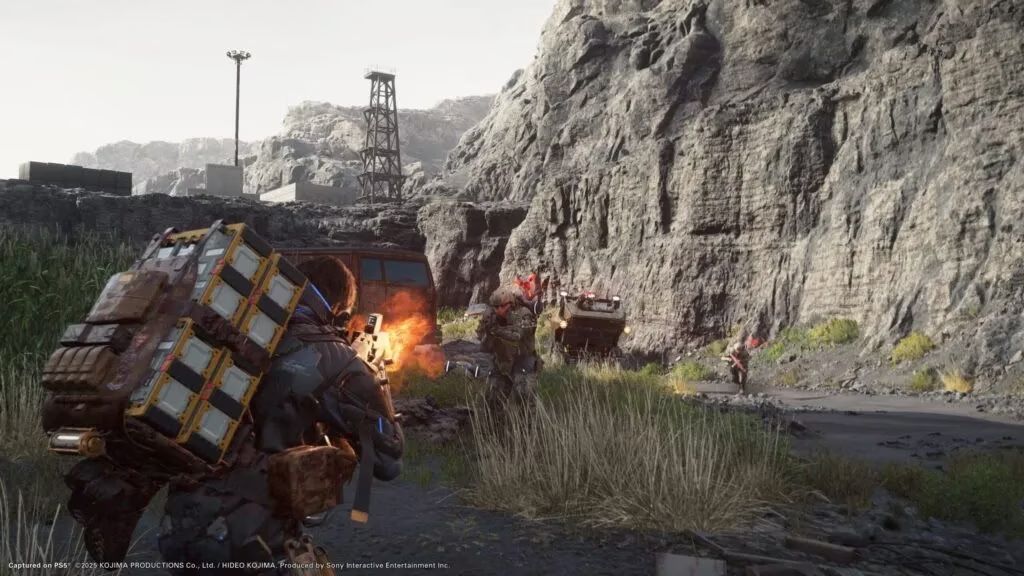
What makes the mode stand out is its connection to the larger story. New missions unlock as the player progresses through the campaign. This structure prevents the training space from feeling like a one-time tutorial. It grows alongside Sam's journey, offering new drills and scenarios that reflect the evolving dangers of the world. The mode also ties into the game's broader social loop through the accumulation of Likes. Players who return and refine their skills can build consistency, much like a porter who improves with every delivery.
For PlayStation 5 owners, VR Training Mode is already live. It can be accessed from the Private Room aboard the DHV Magellan, the vessel that serves as a hub during Sam's travels. From that private space, players can step into training without leaving the narrative's sense of place. It is a small but meaningful detail that keeps the feature rooted in the fiction rather than treating it as an external menu.
PC players will gain access to the same tool when Death Stranding 2: On the Beach launches on March 19, 2026. The timing matters because the PC audience includes many players who may be experiencing this sequel for the first time. A robust training mode can soften the learning curve and make the game's complex systems feel more approachable. At the same time, it gives returning players a way to stay sharp after the main story has ended.
The benefits of regular practice are clear. Here are some of the areas the mode helps players refine:
-
🎯 Combat timing – Sam's encounters can shift from quiet exploration to violence quickly, and precise timing is essential.
-
🧗 Movement and traversal – Uneven terrain, climbing, and balancing cargo all require deliberate control.
-
📦 Load management – Understanding how weight and positioning affect movement can prevent disaster.
-
🧠 Muscle memory – Repeated drills build instincts that free players to react rather than hesitate.
A comparison of what players can expect from the training mode shows why it is more than a simple practice arena.
| Feature | Details |
|---|---|
| Availability | Live on PS5; included with PC launch on March 19, 2026 |
| Access point | Private Room aboard the DHV Magellan |
| Mission progression | New missions unlock through the story |
| Reward loop | Players can accumulate Likes by improving |
| Post-story value | Offers continued play after the main campaign |
The trailer positions VR Training Mode as an invitation. It tells players that the world of Death Stranding 2 can be learned, not merely endured. That message is especially useful for a sequel known for dense systems and a deliberate pace. By focusing on preparation, Kojima Productions highlights the satisfaction that comes from mastery rather than simply advancing from one cutscene to the next.
Practice makes perfect, as the old saying goes, and Death Stranding 2 appears willing to give players the space to test that idea. Whether someone is new to Sam's journey or returning after months away, the training mode provides a grounded way to reconnect with the game's rhythms. The PC launch brings that opportunity to a broader audience, and the latest trailer makes the case that a little time spent in the virtual training space can change the way the rest of the journey feels.
Comments